
Bilbao, with almost 350,000 residents, is a major city in northern Spain that has transformed itself from an industrial hub shaped by its estuary into a city of advanced services, technology and knowledge. Today, it stands at a new turning point, where climate resilience and ecological transition are becoming central to its urban future.
This context makes Bilbao especially relevant to JUST4CARE. The city has a long trajectory in addressing flood risk, while more recently it has started to confront rising temperatures, heatwaves and the need to renaturalise its streets and public spaces. Although its summers are milder than those of several pilot cities, Bilbao increasingly shares concerns around heat stress, social vulnerability and the unequal capacity of different groups to adapt.
Bilbao’s interest in JUST4CARE lies in strengthening a just approach to climate adaptation, one that combines environmental transformation with social cohesion, equality and care for the most vulnerable. The city is particularly interested in how public authorities and communities can work together to design, prioritise and evaluate adaptation measures in ways that are both effective and socially fair.
Through this exchange, Bilbao is looking for practical ways to involve vulnerable groups in decision-making, to establish criteria for prioritising action across the city, and to better anticipate and assess the different benefits that climate adaptation measures can bring to different parts of the population.
The aim is for both public authorities and citizens to be aware of the need for these actions, to be involved in their design, and to be informed about and benefit from the outcomes of the measures implemented.
Bilbao detailed information:
Bilbao lies on the Atlantic coast and has a humid oceanic climate, with prevailing westerly winds that moderate temperatures and ensure mild weather throughout the year: an average temperature of 8°C in winter and 20°C in summer (data collected since 1947 indicate that Bilbao has an average annual temperature of 14.4°C).
Bilbao was an industrial city in the late 1970s, with a certain sense of decline and industrial activity centred around the estuary, which had a major impact on the environmental health of the surrounding area. However, at the end of the last century, the estuary and its regeneration became the driving force for change, and Bilbao transformed itself into a city of advanced services, technology and knowledge.
This places the city on the cusp of a third transformation, following the industrial (mid-20th century) and urban (late 20th century) transformations. The 21st-century transformation—that of technology and knowledge—seeks to integrate the ecological transition and resilience to climate change.
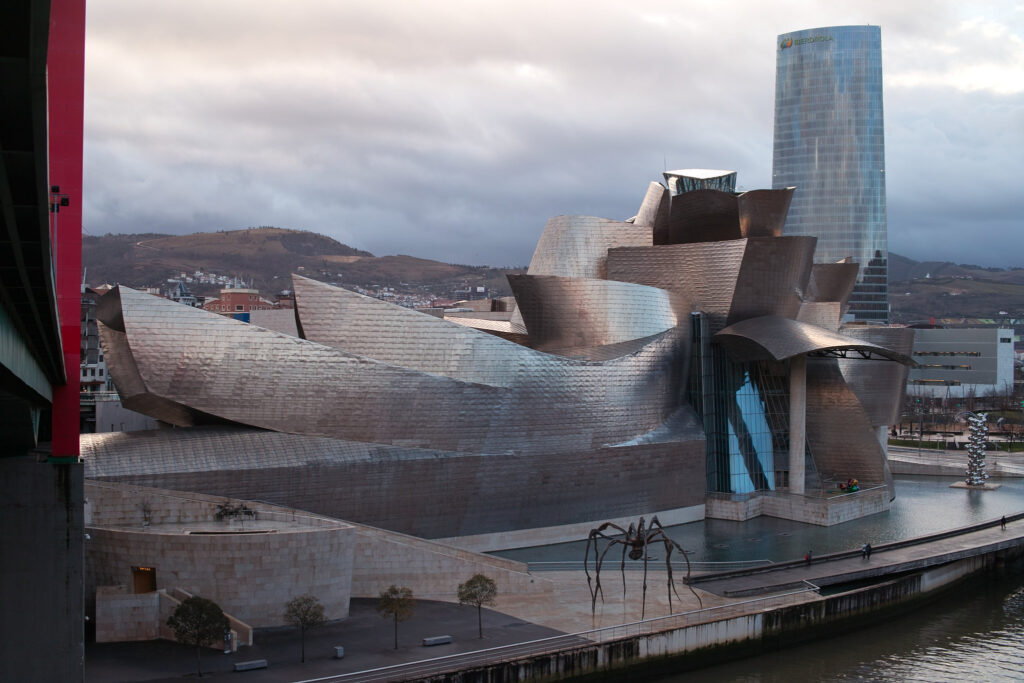
Bilbao specific vulnerability challenges
The average temperature in Bilbao has risen by approximately +1°C since 1990, with an annual increase of +0.04°C per year. Over the years, Bilbao has experienced an increasing number of days each year with temperatures exceeding +35°C.
Due to the relatively frequent and persistent weather fronts affecting the northern part of the Iberian Peninsula, rainy spells occur in succession over periods of several days. It is observed that Bilbao experiences torrential rain events annually and that the frequency of these extreme events is on the rise.
Furthermore, projections regarding sea-level rise indicate an increase of +65 cm above current levels by 2100, meaning that in the future, parts of Bilbao’s urban area will be inundated with salt water.
In conclusion, Bilbao is a city that has evolved over recent decades to address the risk of flooding and which, more recently, is seeking to adapt to the increase in heatwaves through the renaturalisation of its streets.
Compared with the pilot cities, it shares with Ankara and Budapest a concern for protecting the city from the risk of flooding. With regard to the impact of heatwaves, Bilbao has milder summers than the pilot cities, without heatwaves as intense or prolonged as theirs, although with average summer temperatures closer to those of Zagreb.
Bilbao alignment with JUST4CARE
Whilst, for historical reasons, Bilbao has been adapting the city to the risk of flooding for decades, awareness of the issues associated with heatwaves is a more recent development. This means rethinking the city in terms of urban planning, renaturalisation, municipal services…
This necessary transformation must integrate the needs of the most vulnerable groups in terms of health during heatwaves into the design of interventions; but the transformation Bilbao needs to become resilient to climate change must also incorporate the city’s needs in terms of social cohesion, equality and social justice. All of this requires new forms of municipal action and engagement with citizens, focusing on the most vulnerable groups, in order to carry out processes of ecological transition and just climate adaptation.
The aim is for both public authorities and citizens to be aware of the need for these actions, to be involved in their design, and to be informed about and benefit from the outcomes of the measures implemented.
Bilbao as part of the Community of Practice
As part of the Community of Practice, Bilbao is also interested in sharing its own local challenges with the pilot cities and following the development of pilot activities closely.
A specific interest for Bilbao is the evaluation and monitoring work developed under the pilot’s work. The city wants to understand how pilot actions are assessed, how social fairness is monitored, and how learning from Madrid, Çankaya, Budapest and Zagreb can inform its own climate adaptation priorities.
Explore more replicant cities: