What happens when the categories we use to protect people prevent us from understanding why some experience the impacts of climate change much more severely?
A heatwave affects an entire neighbourhood. Yet not everyone can protect themselves in the same way. Some people have a cool home, a nearby family network or enough resources to change their routines. Others live alone, work outdoors, struggle to access decent housing or lack spaces where they can shelter from the heat.
To describe these differences, we often use one word: vulnerability.
But does this word really help us understand what is happening?
This was the question running through the third meeting of the Tetuán Equality Commission, held on 19 June at Lorenzana, as part of the learning process accompanying the activities of the JUST4CARE pilot in Madrid.
This was not a seminar aimed at finding the correct definition. It was a workshop designed to pause and look closely at the words we use to understand reality, and to ask what they allow us to see , and what they may hide.
When a word that seems to explain everything stops us from understanding reality
The session began with a simple exercise. In pairs, participants wrote down what the word “vulnerability” meant to them.
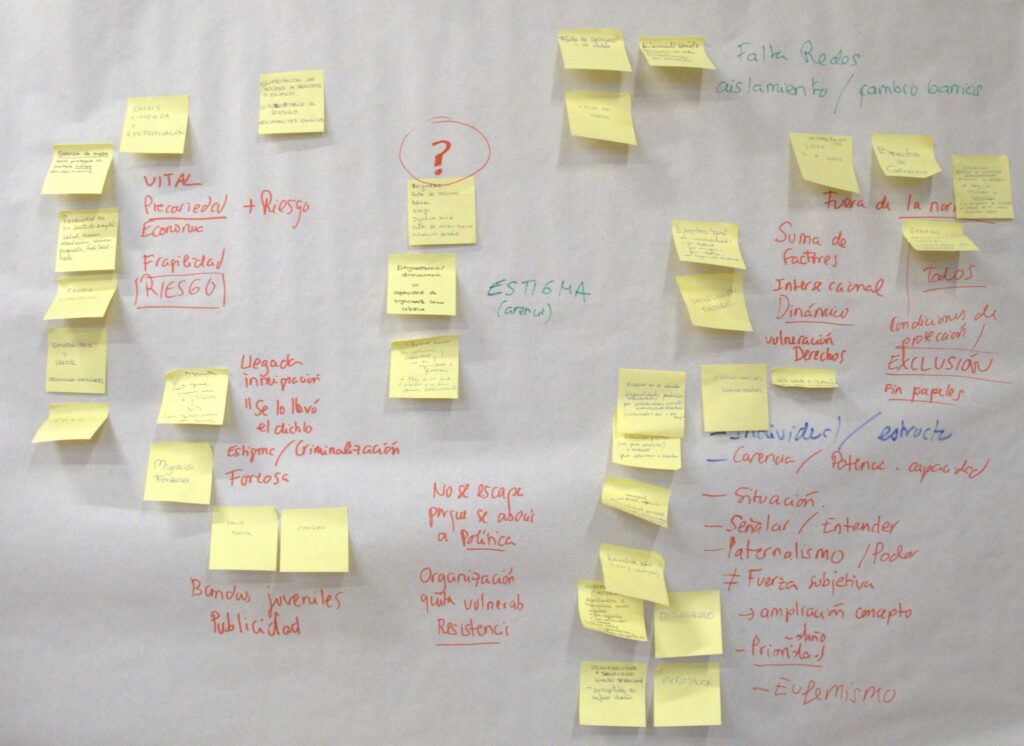
The answers were numerous and diverse: isolation, lack of support networks, poverty, inequality, discrimination, housing problems, migration, health, age, gender, unequal access to resources, and lack of means to protect oneself from heat, cold or violence.
This diversity of answers revealed something important: vulnerability is not a characteristic of certain people. It is a situation that appears when different inequalities intersect. It depends on context and can change over time. Illness, eviction, the loss of a family network or a heatwave can turn a relatively stable situation into something completely different.
But the conversation did not stop there.
The problem is not only identifying who is vulnerable
An important part of the discussion revolved around a shared concern: the word “vulnerability” can help identify priorities for public action, but it can also shift attention away from causes and onto people.
When we classify people as vulnerable, we risk stopping asking what social relations produce that situation: exclusionary housing markets, precarious work, economic inequalities, discrimination, disappearing community networks, institutions that fail to guarantee rights, or neighbourhoods where spaces for meeting and mutual support are disappearing.
As the workshop itself noted, the term can become “a political instrument to intervene or point at, rather than to understand”. It can also individualise deeply collective problems, hiding the power relations that generate them.
This is not just a terminological discussion. It means accepting that categories are never neutral. They organise how we see the world and condition how we act.
Understanding before intervening
One of the most repeated ideas during the session was that it is impossible to design better responses without first understanding reality more deeply.
The contribution by Daniel García, from the Fourth World movement, insisted precisely on this point. Instead of starting with categories, he proposed starting from the experience of people who live in poverty first-hand. Not in order to collect testimonies, but to produce knowledge together with them.
When these experiences occupy the centre, aspects emerge that indicators rarely show: institutional mistreatment, shame, invisible contributions, hidden capacities, and the enormous everyday effort required to sustain life in situations of exclusion.
Fourth World works with the dynamics of “Merging of Knowledge” ( “Cruce de saberes”). From their experience, the challenge is not only to listen to people who experience poverty, but to build a dialogue in which everyone can also review their own position, privileges and ways of understanding reality.
Adapting cities also means adapting our questions
Carlos Pereda added another perspective. After decades researching poverty and exclusion, he recalled that figures change less than we tend to imagine because social structures change very slowly and inequalities persist. He therefore invited participants to place poverty back where it belongs: as a political and collective issue, not only as the sum of individual problems.
We need to repoliticise poverty
This reflection connects directly with climate adaptation and the challenges of JUST4CARE.
When we talk about heat, we often ask where more trees, more shade or better infrastructure are needed. These questions are necessary, but they may not be enough.
We also need to ask who can protect themselves from heat and who cannot; who has support networks; who has time; who has access to adequate housing; who takes part in decisions. Above all, we need to ask what capacities already exist within communities to care for one another, and how these can be strengthened without being replaced.
Another powerful idea emerged during the workshop: people are not only carriers of needs or deficits; they also build solutions through their capacities.
Neighbourhood networks, mutual support, community organising and everyday care are social infrastructures for adaptation. Yet they rarely appear in technical diagnoses.
A conversation that continues
The meeting ended by identifying groups particularly exposed to heat in the district — including people experiencing homelessness and families with children — in order to identify not only their needs, but also the capacities, networks and forms of organisation that already exist and can become part of the response to extreme heat.
Perhaps this is one of the main lessons of the session: understanding better does not mean identifying and classifying better. It means paying closer attention to the relationships, causes and capacities that already exist in neighbourhoods.
Because heatwaves do not create inequalities. They make them visible. And the words and narratives we use to name them are also part of the adaptation process.
Authorship: Aurora demsoc