A first experiment in listening to the neighbourhood through everyday life, and using what we hear to explore new ways of participating.
Marta Burgo Arregui
Espacio Bellas Vistas
How do we talk about heat, care and climate adaptation with the people who live in a neighbourhood? And where do we ask those questions?
Alongside the participatory processes already under way in Bellas Vistas, and in dialogue with the work GEA21 is developing within the Madrid pilot, we at Espacio Bellas Vistas have been thinking about other ways of reaching people.
Our starting point is our own experience as neighbours, together with participant observation and active listening in meetings and shared spaces. But we also wanted to develop a tool of our own within JUST4CARE: something that could help us listen to people through their everyday experiences of climate adaptation. How do we use a square? Where do we look for shade? What spaces are missing? Where do we feel able to stop, rest or spend time?
This is where the Climate Shelter Kit came from: a mobile tool designed to take these conversations into different parts of the neighbourhood and gather the voices, needs and proposals of the people who live there.
But the Kit also opens a door to a bigger conversation. It allows us to move from shade, water or a place to sit towards questions of climate justice, unequal protection and urban rights.
A chair, some shade and a school
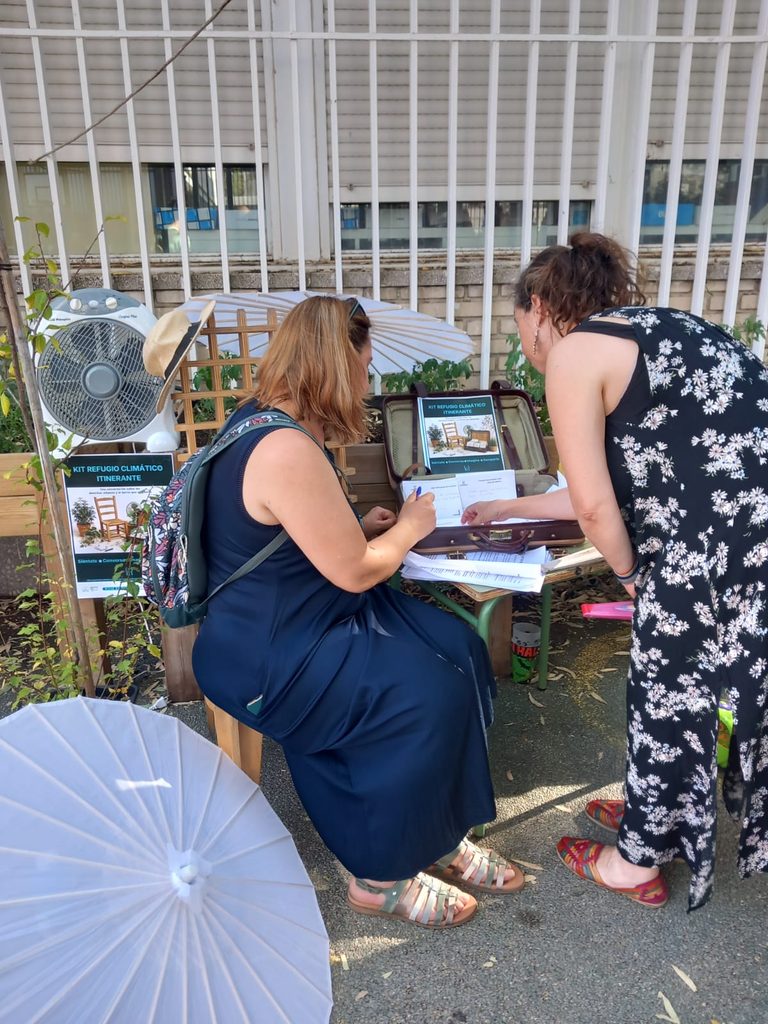
The Kit made its first stop at CEIP Ignacio Zuloaga, during the end-of-school-year celebration organised by the families’ association.
We did not choose the school by chance. It is a place we are already part of. We have been there as families, neighbours and professionals, coordinating projects and building relationships with the school, the families’ association and the wider school community.
That previous trust matters. It allows us to try something new without having to begin by explaining who we are. Instead of creating a separate participation event, we could join a moment that was already part of neighbourhood life.
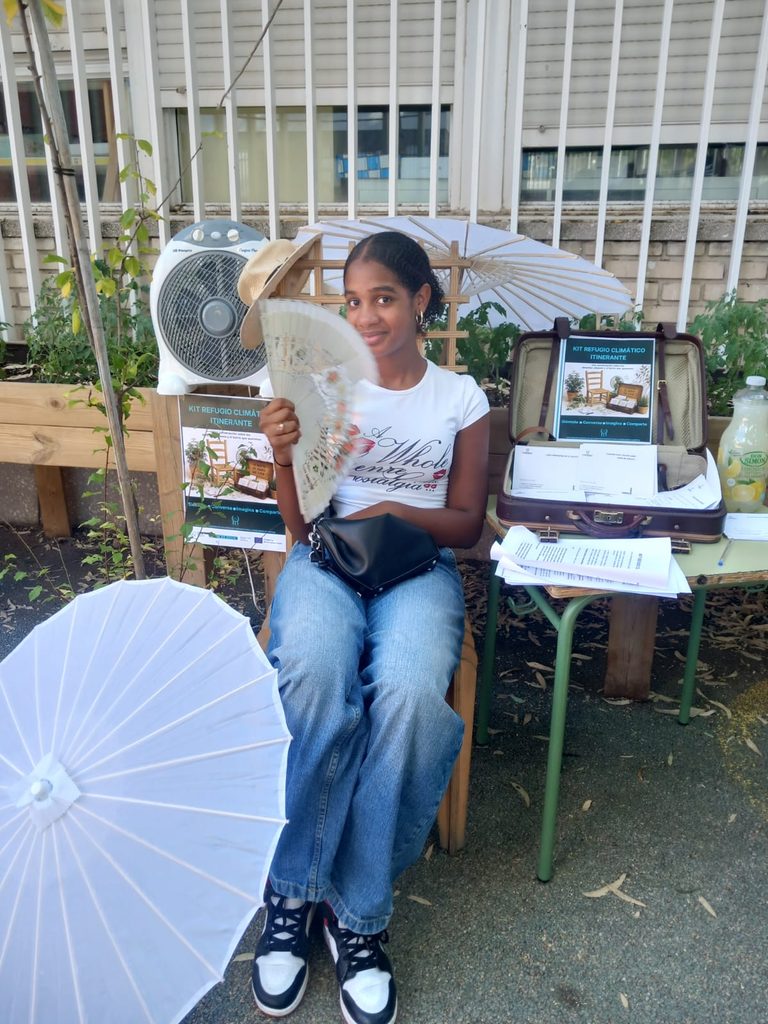
The Kit arrived with a chair, a travelling suitcase, a fan, plants, a water mister, hand fans, parasols and some questions.
The chair gave people somewhere to sit. The shade gave us a concrete way to begin talking about heat. And individual question cards helped open the conversation:
What do you miss when the weather gets hot? Who needs more care? What would you protect in your neighbourhood? What would you remove? In your neighbourhood, do you have the right to…? What would you add?
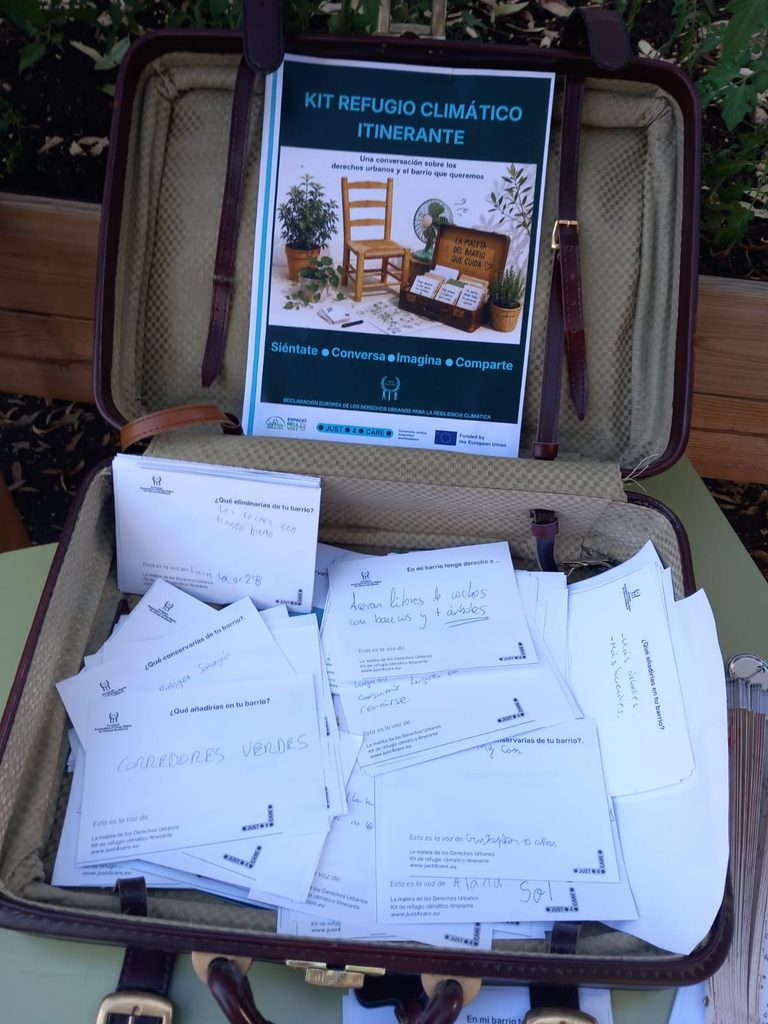
They are simple questions. But behind them lie much bigger issues: access to public space, care, inequality, mobility, nature and health.
Ultimately, they lead us to ask what it means to have the right to live in a neighbourhood that remains liveable as the climate changes.
The Voices of Zuloaga include very concrete requests. Some are things we already know are needed: “Trees that provide shade on every street,” “places where you can spend time without having to buy anything,” “more benches in the shade,” or “a drinking fountain at the school.”
Others are equally rooted in daily life: water sprays in the streets, awnings, fans and parasols, or a public indoor place where families can go with children when the heat becomes intense.
When we asked people what they would keep in their neighbourhood, they mentioned the library, parks, the school, the community garden, trees, shade and their own homes.
And they also mentioned something that is much harder to draw on a map: the people.
That answer has stayed with us.
It made us think about a right we want to keep exploring: the right to protect and strengthen the places, relationships and resources that already sustain everyday life.
A neighbourhood already contains people, associations, spaces, routines and networks of care. Climate adaptation cannot only be about adding something new. It also has to ask what already protects people, how it can be supported, and how we avoid placing even more responsibility on those who are already doing the work of care.
A tool that learns as it travels
Our first experience at Zuloaga also taught us something about the Kit itself.
An end-of-year school celebration is busy. People are moving, meeting friends, looking after children and having several conversations at once. It was not the right setting to ask people to stop for a long interview.
So we chose not to record testimonies that day.
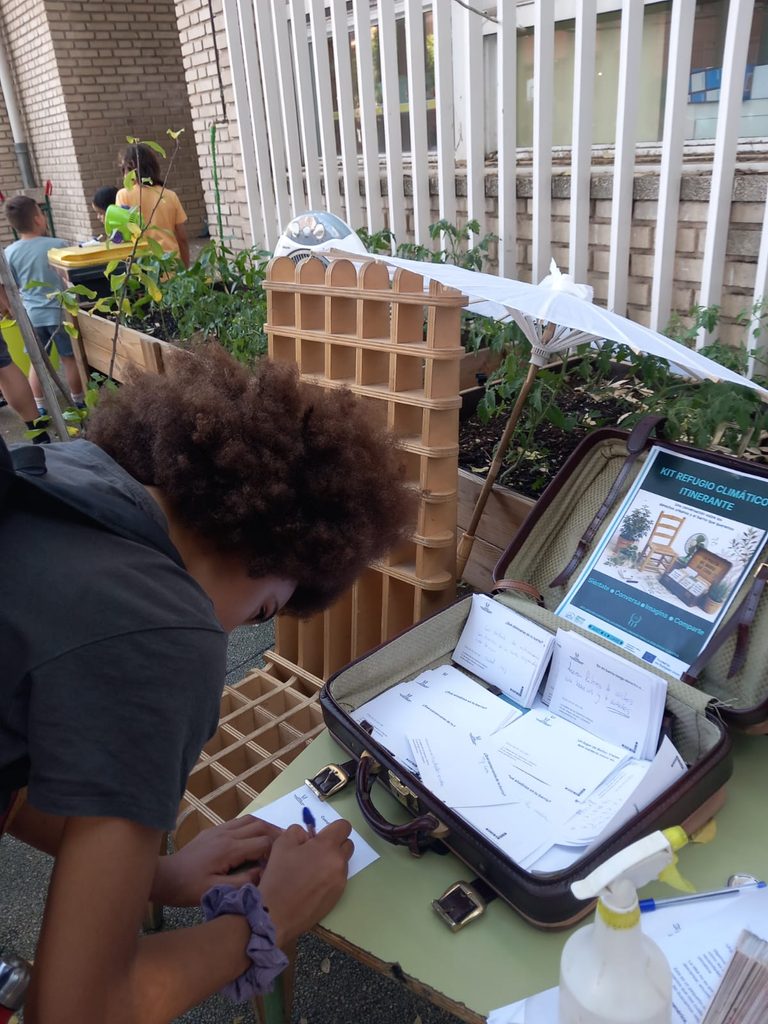
Instead, the cards became a simple and playful way to participate. People could write down an idea, make a drawing, answer a question or leave a proposal. Someone who does not want to speak may still want to represent an idea in another way.
We like to think of the Climate Shelter Kit as mobile and adaptable. It changes according to the place, the people and the moment.
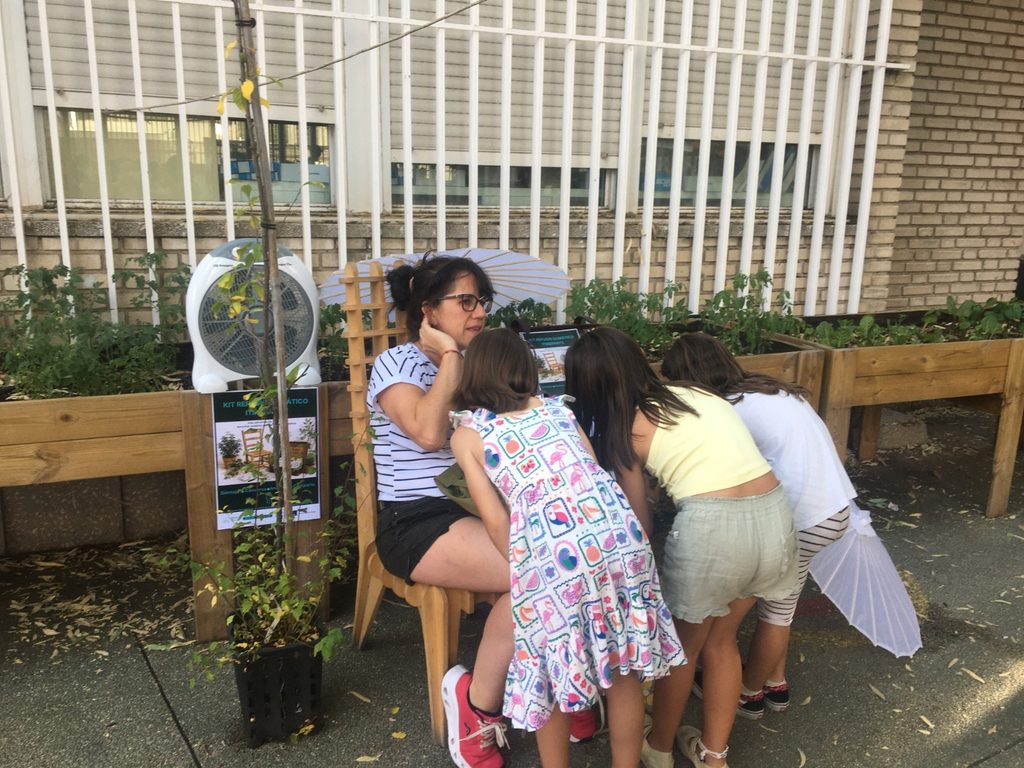
In a few months, perhaps the water mister will be replaced by a blanket and the fan by an umbrella. Different seasons may open different climate conversations.
Listening also means changing the way we ask.
From the first voices to something bigger
This first stop has opened questions within JUST4CARE too.
Which questions work best? Where does it make sense for the Kit to stop? When is a card enough to capture an idea, and when do we need a longer conversation? How do we explain JUST4CARE without making the project itself the centre of the exchange?
Because communicating a project is not only about telling people what JUST4CARE is. It is also about finding the questions, places and ways of listening that allow people to enter the conversation on their own terms.
The number of cards collected at Zuloaga is modest. They are not meant to represent the whole neighbourhood. But they raise large questions and create new possibilities.
The contributions are feeding into DemSoc’s work around the EU Declaration of Urban Rights for Climate Resilience, connecting what is heard in the neighbourhood with a wider reflection on the rights and conditions needed for liveable everyday life.
This first experience is also informing the planning of the Local Parliaments in Tetuán.
The aim is to continue creating spaces where local voices are not simply collected and stored, but can circulate, meet one another and become part of collective conversations about the neighbourhoods we want to live in.
The Climate Shelter Kit will keep travelling. At every stop, we hope not only to hear new voices, but also to learn new ways of listening.
Next stops
Bellas Vistas neighbourhood festivities: https://www.instagram.com/p/Ddd1svdEd06/?stkn=N3hqenI4bW14a29q
Tetuán Associations Fair — 17 October
SPANISH VERSION:
Una silla, una sombra y muchas preguntas: la primera parada del Kit de Refugio Climático
Una primera experiencia para escuchar el barrio desde lo cotidiano y seguir construyendo, a partir de ahí, nuevas formas de participación.
Marta Burgo Arregui
Espacio Bellas Vistas
¿Cómo hablamos de calor, de cuidados y de adaptación climática con las personas que viven en un barrio? ¿Y dónde hacemos esas preguntas?
En paralelo a los procesos participativos que se están impulsando en el barrio, y en diálogo con el trabajo que se viene desarrollando con GEA21 dentro del piloto de Madrid, desde el Espacio Bellas Vistas llevamos tiempo pensando en cómo encontrar y fomentar otras formas de acercarnos a las personas. Además de nuestra propia experiencia como vecinas, de la observación participante y de la escucha activa en encuentros y espacios compartidos, queríamos desarrollar alguna herramienta propia relacionada con el proyecto. Queremos escuchar y recoger las voces de nuestros vecinos y vecinas a partir de sus experiencias cotidianas relacionadas con la adaptación climática: cómo usamos una plaza, dónde buscamos sombra, qué espacios echamos de menos o en qué lugares sentimos que podemos estar.
De esta idea nace el Kit de Refugio Climático, una herramienta que hemos desarrollado para llevar estas conversaciones a distintos espacios del barrio y recoger las voces, necesidades y propuestas de quienes lo habitan. Pero también como una puerta de entrada para hablar de justicia climática, de vulnerabilidad o de derechos urbanos.
Una silla, una sombra y un colegio
La primera parada fue el CEIP Ignacio Zuloaga, durante la fiesta de fin de curso organizada por el AFA. La elección de este centro no fue casual, es un centro del que somos parte, en el que hemos participado como familias, como vecinas y como profesionales coordinando proyectos y construyendo complicidades con el colegio, el AFA y las familias. Existe una confianza previa que hace posible probar algo nuevo sin tener que empezar por explicar quiénes somos, y nos permite integrarnos en una actividad que ya estaba ocurriendo.
El Kit llegó al colegio con una silla, una maleta viajera, un ventilador, plantas, un pulverizador, abanicos, sombrillas y algunas preguntas. La silla servía para sentarse, la sombra, para hablar del calor desde algo muy concreto. Y las preguntas impresas en tarjetas individuales, para abrir la conversación. ¿Qué echas de menos cuando hace calor? ¿Quién necesita más cuidados? ¿Qué conservarías de tu barrio? ¿Qué eliminarías? ¿En tu barrio tienes derecho a…? ¿Qué añadirías?
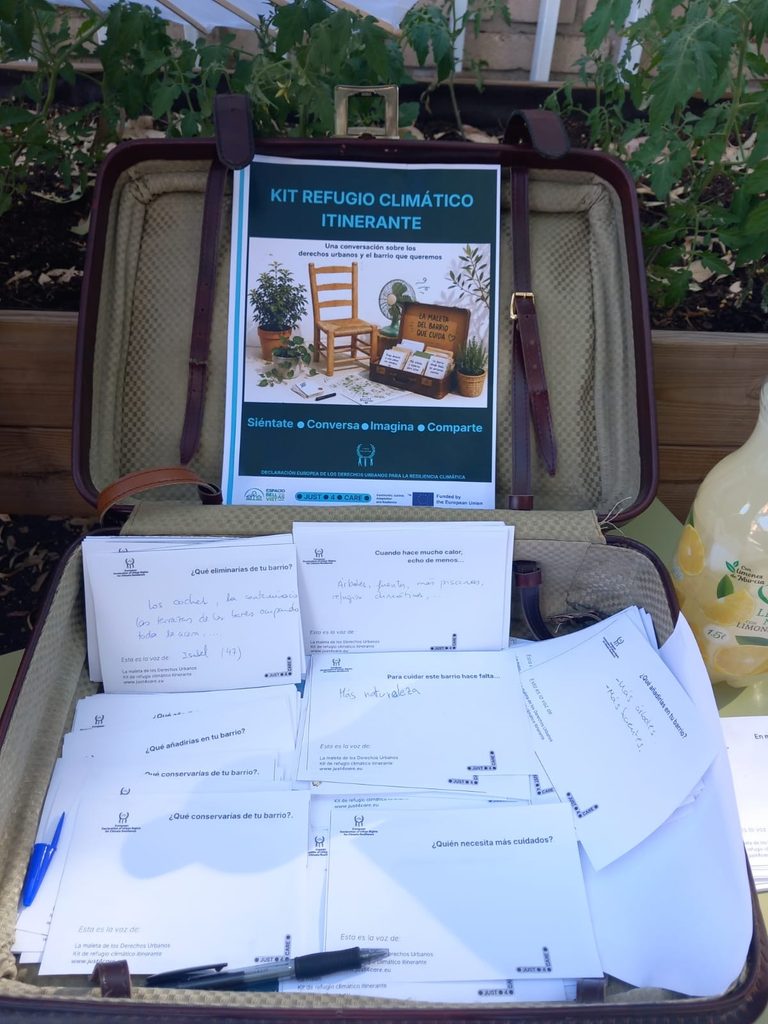
Son preguntas sencillas, pero detrás de ellas aparecen cuestiones mucho más profundas: el acceso al espacio público, los cuidados, la desigualdad, la movilidad, la naturaleza, la salud y, en definitiva, el derecho a vivir en un barrio habitable.
Las Voces del Zuloaga recogen demandas concretas, que ya sabemos: “Árboles que den sombra en todas las calles”, “espacios para estar sin consumir”, “más bancos a la sombra” o “una fuente en el colegio” O deseos muy cotidianos: chorros de agua en las calles, toldos, abanicos y sombrillas, algún centro público donde poder estar con niños y niñas cuando hace mucho calor.
Cuando preguntamos qué conservarían de su barrio aparecieron la biblioteca, los parques, el colegio, la huerta, los árboles, las sombras, la propia casa y, también, algo más difícil de dibujar en un plano: la gente.
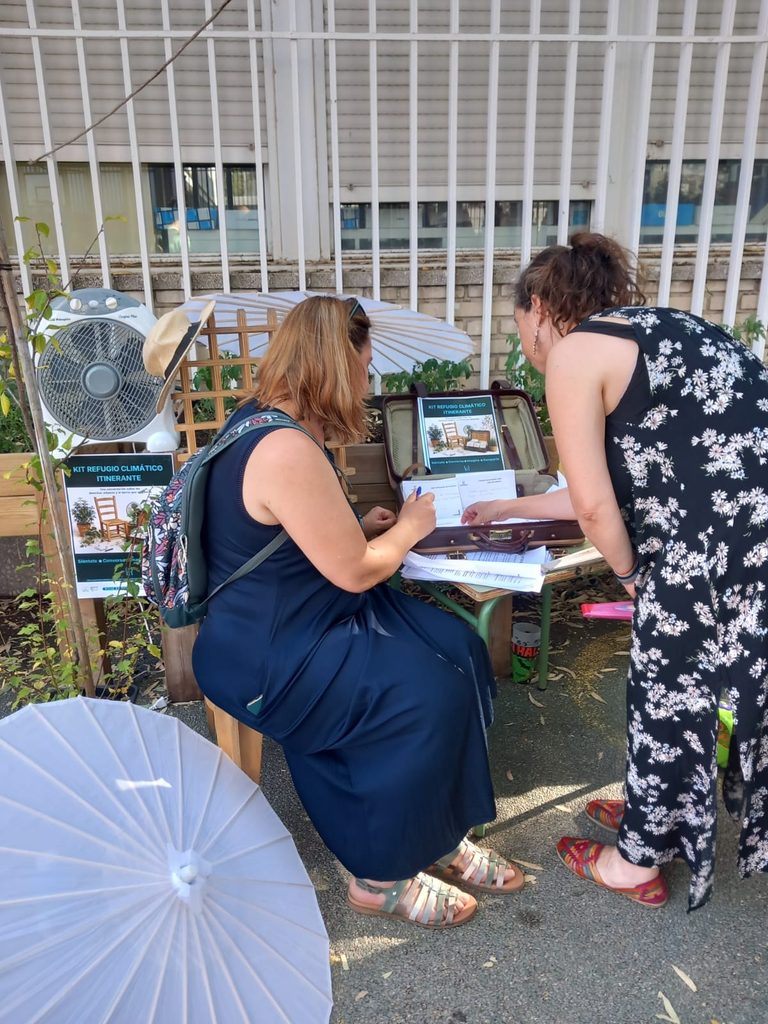
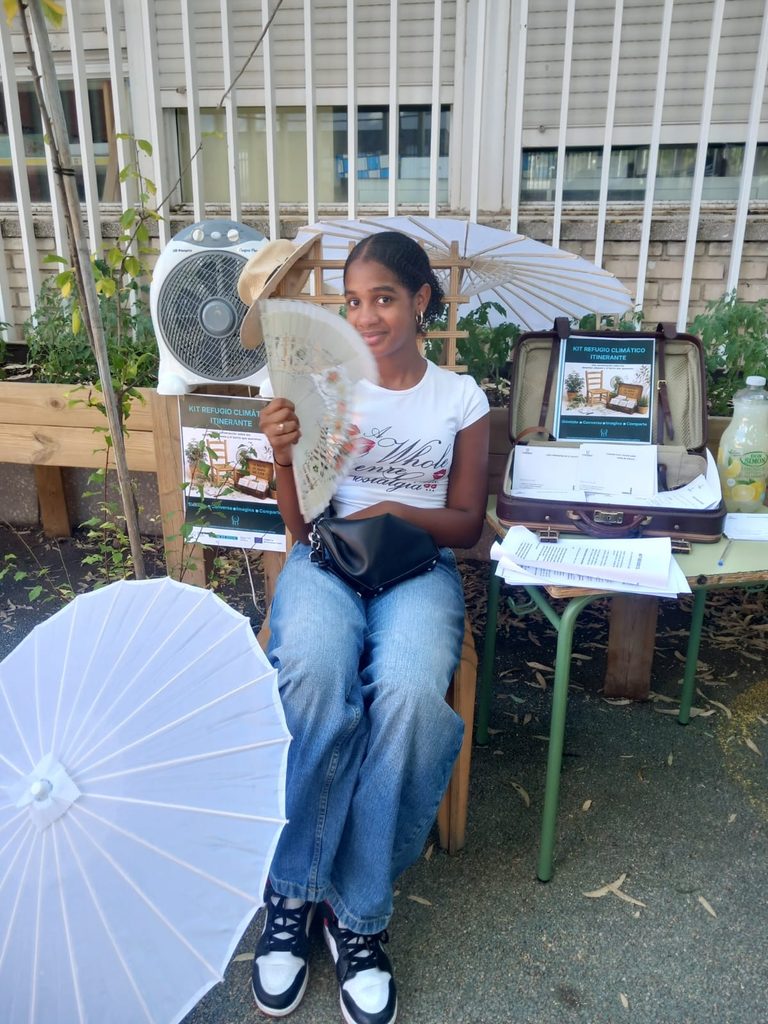
Esto nos hizo pensar en una idea que queremos seguir explorando: el derecho a reforzar los lugares y elementos que ya protegen la vida cotidiana. El barrio ya tiene personas, espacios, asociaciones, costumbres y redes que forman parte de los cuidados cotidianos. La cuestión también es cómo reconocerlas, reforzarlas, protegerlas y no dejar toda la responsabilidad de los cuidados sobre quienes ya los están sosteniendo.
Una herramienta que aprende mientras se utiliza
La experiencia del Zuloaga también nos permitió aprender sobre el propio Kit y las distintas formas de utilizarlo. Una actividad familiar de final de curso es un espacio lleno de movimiento, encuentros y conversaciones simultáneas. No era el momento para pedir a las personas que se parasen durante mucho tiempo ni para convertir cada conversación en una entrevista. Por eso, por ejemplo, decidimos no grabar testimonios aquel día.
En cambio, las tarjetas funcionaron como una forma sencilla y divertida de participar: escribir una idea, hacer un dibujo, responder una pregunta o dejar una propuesta. Quizás haya personas que no quieran hablar pero sí representar su idea de alguna manera.
Nos gusta pensar que es una herramienta móvil, y adaptable, que cambia según el lugar, las personas y el momento. Quizás en unos meses cambiemos el pulverizador de agua por una mantita; el ventilador por un paraguas y se abran otras conversaciones climáticas.
De las primeras voces a algo más grande
Esta actividad también ha abierto una conversación dentro del propio proyecto. ¿Qué preguntas funcionan mejor? ¿En qué espacios tiene sentido hacer una parada? ¿Cuándo una tarjeta ayuda a recoger una voz y cuándo necesitamos generar una conversación? ¿Cómo presentamos Just4Care sin que el proyecto se convierta en el centro de la conversación?
Porque comunicar el proyecto no consiste solamente en contar qué es Just4Care. También implica encontrar las preguntas, los lugares y las formas adecuadas de llegar a las personas.
Las tarjetas recogidas en el Zuloaga no son muchas, pero abren preguntas grandes y nos abren otras oportunidades. Sus aportaciones se están incorporando al trabajo que está realizando DemSoc en torno a la Declaración de Derechos Urbanos, conectando lo que ocurre en el barrio con una reflexión más amplia sobre los derechos y las condiciones necesarias para una vida cotidiana habitable. Y, al mismo tiempo, esta primera experiencia está siendo el germen de la planificación de los Parlamentos Urbanos en Tetuán.
La idea es seguir creando espacios en los que las voces del territorio no sean solamente recogidas, sino que puedan circular, encontrarse y formar parte de conversaciones colectivas sobre cómo queremos que sean nuestros barrios. El Kit seguirá viajando y con cada parada esperamos no solo recoger nuevas voces, sino también aprender a escuchar de otras maneras.
Próxima parada:
Fiestas de Bellas Vistas (fecha y cartel en el instagram del espacio: https://www.instagram.com/p/Ddd1svdEd06/?stkn=N3hqenI4bW14a29q)
Feria de Entidades de Tetuán (17 de octubre)