Four days of conversations in Zagreb explored a difficult question: how can cities adapt to climate change without reproducing existing inequalities?
According to the American political philosopher John Rawls, justice is “the first virtue of social institutions” (A Theory of Justice, J. Rawls), not a value to be traded off or adapted to circumstance, but the standard everything else must answer to. A society, and thus a city, can be efficient, prosperous, even popular, and still be unjust.
Precisely because it is a standard and not a settlement, justice must be continually questioned. Who is vulnerable, who is unheard, who is pushed out of a city’s plans, this shifts with every generation, every crisis, every change in who holds power. New forms of exclusion continually demand to be named. A justice that stops questioning itself stops being justice. It becomes a word institutions use to describe themselves, not a standard they remain willing to be held to.
This is exactly why projects like JUST4CARE matter and why holding this question open is part of our task. It is also why this blog exists: to unpack justice not as an abstraction but through the lenses (and the actions) the project uses to make it legible in practice: justice, knowledge, governance, cities, and policies. Each lens has a different angle on the same question Just4Care holds: who should we care for when we talk (and act) for Climate justice?
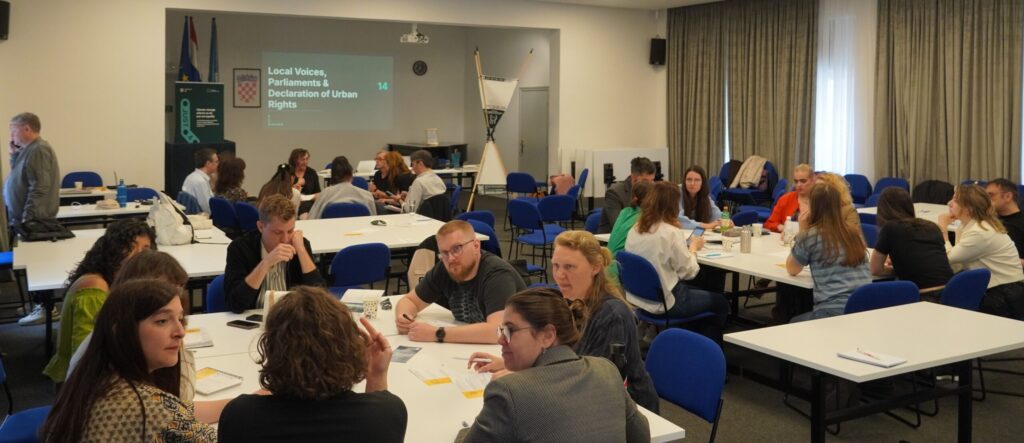
At the end of April, thirty people, researchers, city practitioners, civil society partners, community representatives, gathered in Zagreb to better unpack three of these lenses at once: justice, governance, and knowledge.
Justice does not divide neatly into boxes
The first day opened with an introduction to Nancy Fraser’s framework on justice1: a brief history of environmental and climate justice, and the four categories Fraser uses to think about it, distributional, procedural, recognitional, and a fourth, still-emerging category for cases that do not fit or bridge the other three. These categories express what justice actually requires: a fair share of benefits and burdens, a genuine say in decisions, and recognition as a legitimate subject of policy in the first place.
The practical workshop that followed put this framework into action. Each participant wrote down a real experience of climate injustice, then placed it within one of the four dimensions. Twenty-four cards were written and almost none fit cleanly in only one box.
One testimony is worth citing directly: “In the city where I was born, dozens of people died in the flood. The reason was the construction of buildings in the riverbed.” This card could be read as distributional: the deaths fell on those living in the riverbed. But it is also recognitional: the decision to allow construction there reflects whose safety was considered worth protecting. And it is procedural: those who ended up living with that risk were never part of the planning decisions that placed them there. One card, three failures, layered together.
This difficulty was the most insightful finding of the exercise. Sorting the cards forced an argument that revealed something important: in practice, lack of recognition usually comes first. If a community is not seen as a legitimate subject of policy, no redistribution reaches it, because the people deciding where resources go do not register that the community exists. A second card made the same dynamic visible differently: a road expansion in Zagreb went ahead despite residents raising concerns about noise and pollution near a centre for children with disabilities. They were informed but not heard. Information without recognition is not participation, it is a formality.
This is what unpacking justice through Fraser’s dimensions made visible: not four separate problems requiring four separate solutions, but one entangled condition to be addressed as a whole.
Knowledge and vulnerability: who decides who is at risk
The second day pushed the same question further: not just who is excluded, but who decides what exclusion looks like. Vulnerability, as Just4Care frames it, is not a fixed label. It shifts with the hazard, the place, the moment: someone highly exposed to heat may be barely affected by flooding. That framing refuses the comfort of a fixed list. But it raises a harder question: lists, even flexible ones, still have to be drawn up by somebody.
This is where two ways of approaching vulnerability came into useful friction. One starts from data, maps and models of where risk concentrates across the pilot cities. The other starts from people, from the trust that has to be built before anyone will tell you what their life actually looks like under climate stress. A story from a participatory process in Madrid made the gap vivid: reaching Romani women and unemployed young people for a library co-design process required relationships before it required a survey.
Neither approach alone is enough: data without testimony tends to see only what it was built to look for, testimony without data risks staying anecdotal. But the deeper issue of the conversation was political, not methodological. Knowledge about who needs protection is never neutral, it is produced by someone, using a method that has already been decided, before a single number is collected, who counts as worth seeing. Measuring vulnerability well is not just a technical problem but encompasses the same recognitional question the Justice conversions had already named.
Governance: where justice gets implemented
The third block shifted from defining justice to an institutional question: even where a city wants to act justly, what stops it?
The session opened with a framing shift: from government, top-down through public authorities, to governance, where institutions, communities, and other actors share the work. Just adaptation cannot rely on technical fixes alone, it requires coordination, genuine participation, and institutional capacity to learn over time.
Governance is no longer about who leads, but how we collaborate
City representatives and technical partners were asked to name where they actually had power to act and where they did not. Both groups arrived at the same map from opposite directions. Cross-departmental learning came back as a domain both felt confident in. Climate finance, who decides how it is allocated, came back as a domain neither group felt they could touch.
This is an interesting asymmetry. The barrier to just adaptation is rarely a lack of technical knowledge, and not always political will, many cities already have climate plans. The barrier is structural: responsibilities split across departments without shared goals, decisions made at a level local actors cannot reach. One participant named it precisely: knowledge is fragmented across departments that lack shared objectives. Plans exist but the institutional capacity to carry them out does not. Those outside the institutions, representatives from civic organisations, were clear about their own limits:
We can suggest things, but we don’t have power on it.
This is the same procedural and recognitional gap from the Justice block, now visible at the level of institutions. It points to where Just4Care’s work has to go next: not only helping cities recognise what justice requires, but building the capacity to act on what they already recognise.
Rights: justice as a demand, not a category
The second day moved from analysis to a practical exercise in democracy. Participants took part in a sort of trial run for Urban Parliament — a method initiated by Zuloark in 2011 that will be adopted in Just4Care, giving physical form to public debate: a space to gather, a board to record what is said, and a public forum for individual testimony. This method, previously tested in other projects, aims to produce a living, bottom-up declaration of urban rights that citizens continue to shape. Just4Care draws on this same logic in order to collectively develop a Declaration of Urban Rights for climate justice, built across all four pilot cities over the course of the project. Zagreb served as the first trial run of how that declaration might be drafted – not by experts alone, but by people willing to take the floor and speak out.
Participants were asked three questions: which rights should be protected, which should be newly claimed, which conditions should simply stop.
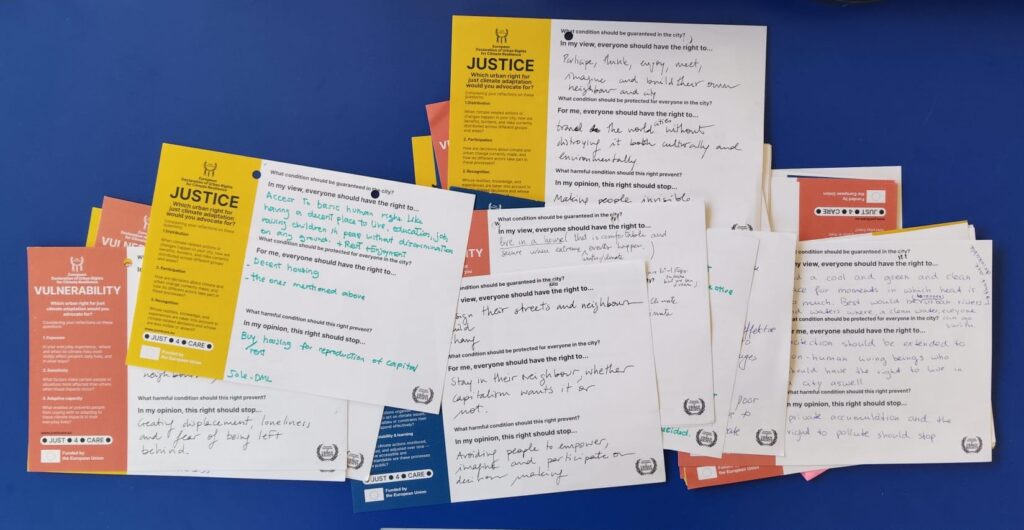
The most frequent demand was the right to shape the place you live in — not to be consulted about it, but to have a real hand in deciding what it becomes. Closely linked was the right to stay, against displacement once a neighbourhood improves. A few cards extended rights beyond the human, one called for non-human life to have standing in city decisions; another, the right to travel between cultures without destruction. These are early articulations of what Fraser’s framework names emerging justice.
Running through nearly every card was the same complaint: top-down decision-making, without real consultation, has to end. Justice, in participants’ own words it is about being allowed to decide.
A visit that made the abstract concrete
On the second afternoon, the meeting stepped outside the workshop room to meet those that live in the city and its spaces. Participants visited a Gerontology Centre in Zagreb’s pilot area, part of a network built on a simple premise: that older residents should be able to stay in their own homes for as long as possible, through regular visits, meal delivery, and continuous contact with people who would otherwise go unnoticed.
The visit was not a detour from the morning’s discussion. It was its tangible illustration. An older person living alone, with reduced mobility, is among those most exposed to a heatwave and least likely to appear in a vulnerability map built only from data. The Centre’s home-care workers, through nothing more sophisticated than regular contact, are often the first to notice that something has changed. This is the situated knowledge the morning’s conversation had argued was essential and usually missing, built from inside, through relationships sustained over time.
It was a reminder that justice is not only decided in workshops and parliaments but also built and rebuilt every day by people recognising who is at risk.
What we are carrying forward
The Zagreb meeting did not produce final answers. It produced better questions, a shared vocabulary, and confirmation that justice is not delivered from above but patiently built through recognition, tested through participation, and ultimately claimed by the people it is meant to serve.
This is why the Zagreb meeting belongs to the query that opened this piece: if justice, like democracy, is a virtue that must be continually cultivated rather than achieved once and maintained, it cannot remain the property of any single institution. It has to become a responsibility shared across a wider community, capable of closing the distance between an official drafting a policy and a resident who was informed about a road, but never actually heard.
More will follow on this challenge, which we carry as a starting core group of the larger community we aim to build.
So stay connected to this space, and you will hear from the Just4Care partners, from the parliaments, and even from the people whose perspectives will become part of the collective learning that JUST4CARE is building.
- Fraser, N. (2008). Social justice in the age of identity politics: Redistribution, recognition, and participation. In Geographic thought (pp. 72-89). Routledge. ↩︎